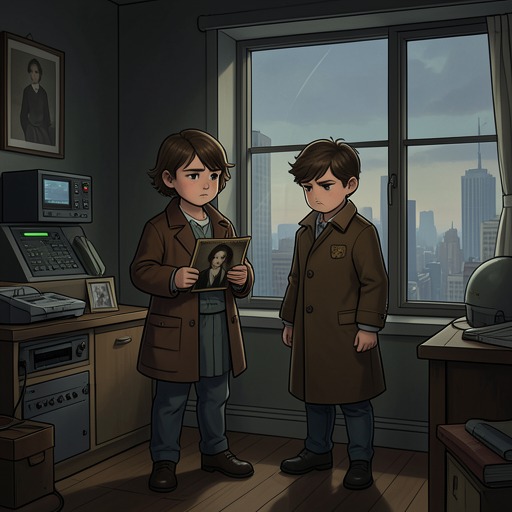
Magnolia Halfdanarson’s death
Big BrotherMagnolia Halfdanarson’s death becomes a defining loss in her family and a test of how grief turns uncertain facts into stories. Her daughter remembers an ordinary, fatal lapse of attention; Edison transforms the same event into suicide, linking it to Travis’s betrayal. The disagreement exposes not only the limits of what the family can know, but also the different meanings its members need the death to bear.
Circumstances of the Death
Magnolia stepped off a curb at the intersection of Foothill Boulevard and Woodland Avenue. A UPS delivery truck barreled past a fraction of a second later, and she died. The narrator insists on the smallness and plainness of the account: her mother stepped off a curb, and that is the whole story. Magnolia had been a good mother in the traditional sense and had taught her children to look both ways. This time, she did not.
That concise account stands against the pressure to make the death into something more deliberate or narratively satisfying. The event offers no elaborate final gesture, only a familiar street crossing and the moment when ordinary vigilance failed. Its starkness is part of what makes the loss difficult: there is no compensating explanation built into the circumstances themselves.
Conflicting Accounts and Family Belief
The narrator and Edison hold different versions of what happened. Edison maintains that he had known for years that Travis was having an affair with Joy Markle; the narrator believes that neither she nor Edison understood the affair until Travis began seeing Joy openly after Magnolia’s death. She adds that the affair did not last. In her account, its later collapse also sharpened the animosity between Travis and Joy, whose portrayals of Emory and Mimi on the television series became more acrimonious and, in the narrator’s view, made its final two seasons the best.
For the narrator, however, the question of when Edison knew matters for a more intimate reason: if he had known about their father’s infidelity all along, she could not bear the possibility that he had kept that knowledge from her. The family’s dispute over the affair therefore reaches beyond the parents’ marriage. It becomes a question of trust between siblings, and of whether Edison’s account of Magnolia’s death rests on information the narrator was denied.
Edison says Magnolia saw the truck and intentionally gave herself up to its bumper, a version of the event that makes her death a suicide. In that telling, Magnolia despaired over Travis’s betrayal, and Travis was responsible for the loss of the bashful, winsome mother who died while the children were teenagers. The narrator understands this account as an expression of Edison’s settled judgment that Travis was an asshole. It gives the death a clear cause in the moral sense, even where the physical circumstances themselves do not establish intent.
The narrator distinguishes facts from beliefs and recognizes the human need to make bereavement signify something. A death understood as pure loss offers no compensation, lesson, or takeaway; an accusation can make the loss feel more bearable by giving grief a target. She argues that even people who are usually honest may reshape the truth into a more dramatic form when they are desperate to make it mean something. Edison’s suicide narrative, in her interpretation, answers that need by making Magnolia’s death part of a legible story of betrayal and blame.
The Narrator’s Reconstruction
Rather than claim certainty about Magnolia’s thoughts, the narrator reconstructs the danger of routine inattention. People make countless basic choices while thinking about something else. She remembers climbing the family’s front-porch steps without consciously directing each movement, her attention occupied instead by whether she could sneak sour cream into the evening casserole without Fletcher noticing. A watchful part of the brain, she reasons, must carry out routine tasks so that the rest of the mind can wander; that overseer, however, is not infallible.
The narrator describes such lapses as moments when the mental overseer blinks out, like a flawed digital recording. Magnolia’s failure to look both ways is, in this account, not evidence of a deliberate wish to die but a terrible instance of an ordinary capacity briefly breaking down. The reconstruction does not undo the death or claim access to Magnolia’s final intention. It offers a natural explanation for how an attentive person could fail once at a task she had taught her children to perform.
Aftermath and Meaning
Years later, in her mid-twenties, the narrator is cycling along a deserted two-lane street in New Holland when she runs directly into a parked car. As she picks herself up and examines the crumpled bicycle frame, she thinks of Magnolia. The collision becomes an echo of the curbside death, but its outcome is different: the narrator survives, and the resemblance makes her newly aware of how often she has negotiated a dangerous world without dying.
She inventories the distractions that have accompanied that survival: devising salsa recipes, dreading Solstice’s impending visits, and contriving phrases for her husband’s pull-string doll. Against those ordinary preoccupations, the number of unremarkable, successful decisions seems almost incalculable. What she takes from Magnolia’s death is not a moral verdict on her mother or a claim that the accident happened for a reason, but incredulous gratitude that the brain performs its work competently nearly all the time.
That modest meaning marks a contrast between the siblings. The narrator can accept gratitude for the mind’s usual competence as enough; Edison, she suggests, needs a much larger plot. She connects his account of suicide with his appetite for Cinnabons and with his tendency to shape his life along dramatic lines. In her reading, even his weight comes to symbolize a kind of vanity: he will not merely endure failure as a small setback, but seems drawn to making success and failure alike grand in scale. Magnolia’s death thus remains a family tragedy while also clarifying the narrator’s resistance to converting every loss into a spectacular explanation.
Narrative Significance
The account makes the difference between an event and the story imposed on it central to the family’s grief. The narrator supplies concrete circumstances—a curb, an intersection, a delivery truck—and acknowledges what those facts cannot settle: whether Magnolia saw the truck or intended to die. Edison’s interpretation gives the loss emotional and moral direction by tying it to Travis’s betrayal. The narrator’s account instead leaves room for accident, distraction, and the unbearable possibility that death may yield no consolation.
Magnolia’s death continues to shape the narrator not through a grand revelation but through an ordinary collision with a parked car. That moment turns memory toward attention, contingency, and survival rather than blame. The episode’s force lies in the gap between what the family knows happened and what it cannot know about intention: grief presses for a plot, while the narrator insists that a plain fact may remain plain, even when it is almost impossible to bear.